The questions arrive in the same order every time. "Will I lose marks for writing don't?" Then "Am I allowed to say I think?" Then, usually a week before the test, "Can I use bullet points if I'm running out of time?"
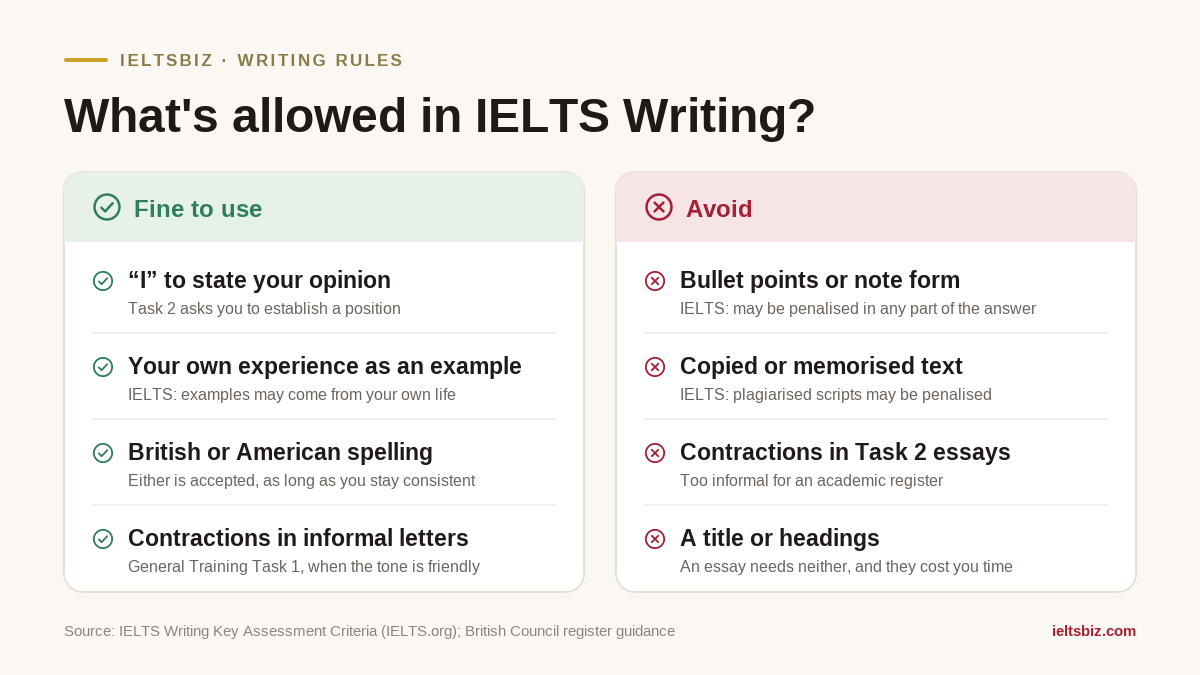
Short answer: IELTS publishes only two hard format rules for Writing. Your answer must be full, connected text, so bullet points and note form may be penalised, and it must not be plagiarised. Everything else, including contractions, "I" and abbreviations, is judged through the four marking criteria, mostly on whether your tone suits the task.
What IELTS actually says
The official IELTS Writing Key Assessment Criteria document is four pages long, and only one sentence in it is a format rule.
Here it is in full: "Candidates should note that scripts may be penalised if they are a) partly or wholly plagiarised, b) not written as full, connected text (e.g. using bullet points in any part of the response, or note form, is not appropriate, etc.)."
That is the whole list. There is no line about contractions, no ban on "I" and nothing about titles. Those questions are answered by the criteria themselves.
Task Response checks "how appropriate the format of the response is to the task". Lexical Resource checks the "appropriacy" of your vocabulary. A General Training letter must "consistently use a tone appropriate to the task".
So the real test is not "is this word allowed?" but "does this word fit this task?"
The same document also says Task 2 carries more weight than Task 1. A register slip in your essay costs more than the same slip in your report or letter.
The quick-reference table
| Can I use… | Answer | Where that comes from |
|---|---|---|
| Contractions (don't, it's) | Not in Task 2 or Academic Task 1. Yes in an informal GT letter | Register advice (British Council) |
| "I" and "in my view" | Yes, to state your position | IELTS: Task 2 asks you to establish a position |
| Personal examples | Yes | IELTS: examples may come from your own experience |
| Bullet points or numbered lists | No | IELTS: may be penalised |
| Note form | No | IELTS: may be penalised |
| Copied or memorised text | No | IELTS: plagiarised scripts may be penalised |
| A title or headings | Not needed | No rule. An essay simply doesn't need them |
| British or American spelling | Either, but stay consistent | Accepted in every skill |
| e.g., etc., & | e.g. in moderation. Avoid etc. and & | Register advice |
| Rhetorical questions | Rarely, and never instead of a position | Register advice |
| More than 250 words | Yes, you won't be penalised | IELTS.org |
Can you use contractions in IELTS Writing?
Not in a Task 2 essay or an Academic Task 1 report. No rule names contractions, but both tasks expect a formal register.
The British Council's own guide to formal and informal English for IELTS says to avoid them, and an examiner reads "it's" and "can't" as a tone problem. In an informal General Training letter to a friend, contractions are natural, and leaving them all out can sound stiff.
The fix costs nothing: write the full form. "It is", "do not", "cannot". In a formal letter to a manager or a company, use the full forms too. One exception is a direct quotation, where you keep the speaker's words as they were said.
Can you use "I" in an IELTS essay?
Yes. Task 2 asks you to "formulate and develop a position", and the clearest way to show a position is often to state it: "I believe", "In my view", "I would argue that". The old school rule that essays must never use the first person does not apply to IELTS.
What hurts you is not the pronoun but leaning on it. "I think" eight times in one essay is repetitive, and Lexical Resource notices. Say your position once in the introduction and once in the conclusion, and let the body paragraphs argue it.
Our guide to Task 2 introductions and conclusions shows where that sentence goes.
Academic Task 1 is different. It is a report on data, and IELTS describes it as relating "narrowly to the factual content" of the visual, "not to speculative explanations". There is no opinion to give, so there is no reason for "I".
Can you use bullet points or numbered lists?
No. This is one of the only two written rules: bullet points "in any part of the response" may be penalised, and so may note form.
It applies to every task, so a GT letter with three bulleted requests is at risk too, even though the task prompt itself shows its three requirements as bullet points.
If you are running out of time, write two short full sentences instead of four bullets. A finished paragraph with simple grammar does more for your band than a list that may be penalised.
Do you need a title or headings?
No. Nothing in the criteria asks for a title, and an essay does not need headings. They earn no marks and take up time you could spend checking. Start with your introduction. The same goes for Task 1: start with a sentence that paraphrases the task, as our Task 1 introduction guide shows.
Can you copy words from the question?
Single key words, yes: you cannot write about "public transport" without using the words. Whole phrases, no. Examiners don't count words copied from the question toward your total, so a copied first sentence can push a 255-word essay under 250.
It also shows nothing about your own vocabulary. Paraphrase instead. Our paraphrasing guide has six ways to do it.
Can you use memorised phrases or a template?
A memorised structure is fine. Knowing that an essay has an introduction, two body paragraphs and a conclusion is preparation, not cheating. Memorised sentences are the problem: "In this day and age, this is a highly controversial issue" fits every essay, so it says nothing about this one.
The public band descriptors list a totally memorised answer among those with no assessable content, which is a Band 0.
Examiners read many scripts, and stock openers stand out. They also sit at a different level from the rest of your writing, which makes it obvious they were learned rather than written. Learn patterns, not paragraphs.
Can you use personal examples?
Yes, and IELTS says so directly: in Task 2, "examples may be drawn from a candidate's own experience". A specific example from your city, job or school is usually stronger than an invented statistic.
"A study by Harvard University shows that 87% of students…" persuades no one when the examiner knows you made it up. A plausible, concrete example in plain words is better.
British or American spelling?
Either is accepted. The only risk is mixing them: "organise" in one paragraph and "organize" in the next reads as a spelling error. Pick one and keep to it. Our guide to British vs American English in IELTS lists the pairs that catch people out.
Abbreviations, symbols and numbers
There is no official list, so these are judgement calls about register:
- e.g. and i.e. are fine in moderation, though "for example" reads more smoothly in an essay.
- etc. signals a list you didn't finish. Give two clear examples and stop.
- &, govt, approx., u are note-taking or texting habits. Write the words out.
- % and digits are normal in Academic Task 1, where you report data: "rose to 45%". In Task 2, small numbers usually read better as words.
Rhetorical questions and exclamation marks
Neither is banned. But a rhetorical question in an essay often stands in for a statement you should have made, and examiners mark the position you state, not the one you hint at. If you want one, follow it at once with your answer.
Exclamation marks belong in informal letters ("It was great to hear from you!") and nowhere in a Task 2 essay.
Can you write more than 250 words?
Yes. IELTS.org says you won't be penalised for writing over 250 words in Task 2, but a very long answer leaves less time to check it.
On the computer test the word count appears below the answer box and updates as you type, so you don't need to count by hand. IDP still advises reading your answer back for typing errors.
For the targets we recommend, see how long your IELTS essay should be.
Tone by task: one table to remember
| Task | Tone | Contractions | "I" |
|---|---|---|---|
| Academic Task 1 report | Formal, impersonal | No | No: you describe data |
| GT Task 1 formal letter | Formal, polite | No | Yes: letters are written in the first person |
| GT Task 1 informal letter | Friendly | Yes | Yes |
| Task 2 essay (both modules) | Formal | No | Yes, to state your position |
For letters, the register decision is most of the task. Our guide to formal, semi-formal and informal GT letters shows how each one opens and closes.
A 60-second check before you submit
- Every point is a full sentence. No bullets, no dashes, no notes.
- No contraction appears in an essay, a report or a formal letter.
- Your position is stated in the introduction and again in the conclusion.
- No sentence is copied whole from the question.
- Your spelling stays British or American from start to finish.
- No "etc." and no "&".
Those six checks catch the habits we see most often. To see which habit is costing you which criterion, run a practice essay through the Writing Task 2 checker. It marks the four criteria separately and quotes the sentence behind every correction, so you can judge each point yourself.